Text by Matthias Boeckl
On the building history of the former Pavillons des amateurs
Austria’s state sculptor studios have been located in the spacious inner-city park of the Prater since 1873. They were originally built as pavilions for the fifth World’s Fair, which, for the first time, was devoted to art on a large scale. A special cluster of buildings was erected for presenting contemporary and historical works: a large art hall, which has not survived, and the two Pavillons des amateurs, in which the collections of private art collectors (Fr. amateurs) were to be shown. Most of the more than 100 buildings erected were demolished once the World Fair ended. The Pavillons des amateurs were repurposed however into sculptor studios and their architectural structure adapted accordingly. Since 1876 they are leased to contemporary artists.
With its focus on art, the Vienna World’s Fair of 1873 contributed to Austria’s identification as a “cultural nation”. Above all however, the world fairs were a genuine expression of the Industrial Age. On the initiative of Prince Albert, who consulted with the inventor and civil servant Henry Cole, Britian – the motherland of industrialisation – had held the first Great Exhibition in London in 1851. Numerous economically advanced nations were invited to present a selection of their best engineering innovations alongside manufactured and industrial products in the imposing Crystal Palace – 615 meters long, 150 meters wide, 39 meters high – designed by Joseph Paxton. This monumental construction of iron and glass created the architectural prototype for all the following world expositions and set the technological standard. From now on the presentations served as stages for showcasing global progress and the economic and cultural competition between nations. The first four world expositions were held by the leading industrial nations Britain and France (London 1851, Paris 1855, London 1862 and Paris 1867). It was only for the fifth that another European Great Power took over the organisation – the 1873 World’s Fair in Vienna.
At this point in time, an irreversible development towards the modern metropolis was already underway in the capital of the multiethnic Austro-Hungarian dual monarchy. Since the failed revolution of 1848 waves of internal migration had seen the city grow massively. By 1873 the population had doubled from around half a million to a million, and by 1910 it would double again to two million. In 1858 Emperor Franz Joseph had ordered the demolition of the old city fortifications (walls, bastions, gates). In their place and on the unbuilt green areas of their glacis the imposing boulevard of Wiener Ringstraße was laid and around 850 public and private buildings erected. The construction boom set off by this “inner city expansion” prompted an enormous demand for artistic services in the fields of architecture, sculpture, painting and the applied arts. The plan was to meet this demand by training the needed artists and this led to the founding of the Vienna School of Arts and Crafts in 1867 (today the University of Applied Arts Vienna).
Parallel to the staging of the World’s Fair, Vienna was also making significant progress in its infrastructure, the very basis for a functioning metropolis. In 1873 the “First Vienna Mountain Spring Water Pipeline” – 150 kilometres in length – was completed; through a series of tunnels and aqueducts it is still supplying the city with the purest drinking water from the Alps. Further, several large hotels were built in conjunction with the World’s Fair, amongst them one on Schottenring by Heinrich Förster and Theophil von Hansen (today the Palais Hansen), the “Hotel Métropole” on Franz-Joseph-Kai by Ludwig Tischler and Carl Schumann, destroyed in 1945, and the hotels “Britannia” on Schillerplatz and “Donau” in Nordbahnstraße.
To absorb the explosive urban growth, from 1870 the large area of the Danube wetlands in the city’s northeast were reclaimed and developed. For centuries the imperial hunting grounds, until then the area had been basically unsuitable for building due to regular flooding. By 1873 a new bed for the Danube had been excavated here as part of a large-scale scheme to regulate the river flow; the numerous smaller arms of the Danube were joined together to form a single straight, navigable main river and alleviate the dangers of seasonal floods. With the wetlands extensively drained, land was now available for large urban development projects.
In 1766 Emperor Joseph II had already made a section of the former court hunting grounds, the Prater, accessible to the public as a recreational area. In 1871 the Prater was then designated to be the site for the World’s Fair and its more than 100 buildings. Enjoying the trust of Emperor Franz Joseph and since 1869 responsible for planning the Imperial Forum on the Ringstraße together with Gottfried Semper (1803–1894), Carl von Hasenauer (1833–1894) was appointed head architect. Both the court museums for the art and natural history collections were also part of this imperial project.
As host of the World’s Fair, Austria-Hungary displayed great ambition and with around 53,000 exhibitors on a site covering some 230 hectares organised the largest global exhibition hitherto ever shown. Its iconic object was a rotunda, 84 m high and 108 m in diameter, built on designs by Carl von Hasenauer and the British engineer John Scott Russell. It remained standing until 1937 when it was destroyed in a fire. The main exhibition halls of the universal show, along with many national and theme-based pavilions, were built as lightweight constructions, either in iron or timber. For the first time, art and culture were defined as central themes of the exposition.
Besides the usual large exhibition halls and thematic pavilions, for the first time there was a distinct and architecturally separate art domain, known as the “Kunsthof” (art court). It comprised a four-aisled “Kunsthalle” (art hall), which extended for some 170 metres in a north-south direction, two smaller exhibition pavilions, built opposite one another on the eastern side of the art hall, and the “Triumphal Arch of the Wienerberger Brick Factory” by Heinrich von Ferstel. An arcade for sculptures linked these four structures and framed the courtyard lying between them, which featured a pond with a small fountain in the middle.
The art hall was located on the current site of Vienna’s trotting racetrack. Like Ferstel’s triumphal arch it has not survived. In contrast to many other exhibition buildings, those making up the art court were built out of brickwork in solid construction. The plans for the three art structures were drawn up by Carl von Hasenauer and Gustav Gugitz (1836–1882). Gugitz was Hasenauer’s project partner in designing the structures for the World’s Fair. He was a pupil of the Ringstraße architects August Sicard von Sicardsburg and Eduard van her Nüll, for whom he oversaw the building of the court opera house (today the Vienna State Opera).
The General Committee of the World’s Fair planned to show the national contributions of the different participating countries in the art hall. In contrast, both neighbouring pavilions were to present an exhibition of private collectors and art enthusiasts (Fr. amateurs), leading to their name Pavillons des amateurs. Analogous to the no longer preserved art hall, these two smaller exhibition buildings comprise two high-ceiling central halls, with zenithal daylight through glass roofs; running off these main halls are three two-span structures which draw their light from windows on the side. On the fourth side of the symmetrically designed buildings, serving as the entrance portico, is a triaxial round-arched loggia with four Corinthian columns that faces out towards the central open space of the courtyard. With simple triangular gables over the side windows, corner rustications, a cornice and a balustrade bearing the dedication inscription “Der Kunst” (“To Art”), the décor of the pavilions corresponded to the unpretentious neo-Renaissance style that had become broadly established in the Viennese Gründerzeit architecture since the 1860s. Groups of figures by Johannes Benk, presenting allegories of the arts, were positioned on the attic; of these, only fragments remain. Carl von Hasenauer was able to draw on his expertise in building structures for art exhibitions from his involvement in planning Vienna’s court museums (1870–1891). After the World’s Fair, his project partner Gustav Gugitz could later contribute the experience he gained to building the Carinthian state museum, the Rudolfinum in Klagenfurt (1879–1884).
During the planning stage in 1872 it became clear that not enough private art collections were applying to present their treasures in the Pavillons des amateurs, forcing the commission responsible for this special exhibition to resign in early 1873. A new expert committee was formed and when it first convened on 7 April, 1873, not even a month remained to put together a radically scaled-down version of the originally planned collectors’ exhibition until the opening of the World’s Fair on 1 May, 1873. A greater part of the halls in the Pavillons des amateurs could therefore be used for the overwhelming number of submissions of contemporary art for the art hall. There was also an exhibition on the construction projects underway on the Ringstraße. A presentation of art collections from Austrian monasteries and museums, quickly arranged by the new expert committee, was limited to a few rooms in the south pavilion.
The floor plan of the pavilions presented in the Officieller Kunst-Catalog (official art catalogue) illustrates the intended positioning of these themes. Contemporary Italian art was exhibited in the north pavilion’s two central halls and the side halls to the right. The halls at the rear showed art from Denmark, Sweden, Britain, Italy, Russia and Greece. Assembled in the halls on the left were works from Switzerland and a small presentation of the monumental buildings on Vienna’s Ringstraße. Amongst others, featured here were designs, perspectival drawings and models of Carl von Hasenauer and Gottfried Semper’s Kunsthistorisches Museum, Friedrich von Schmidt’s Rathaus and Heinrich von Ferstel’s university.
In the southern Pavillon des amateurs art from Sweden, Norway, Denmark and Russia was presented in both central halls and the two rear halls. The side wings showed works from Hungary, Austria and Germany. The southernmost halls were reserved for the art collections of the amateurs. The newly installed expert committee comprised the art historians Karl Lind and Eduard von Sacken and the medieval archaeologist Albert von Camesina. The focus was on sacral decorative arts from the Middle Ages assembled from Austrian abbeys and regional museums, including the famous Tassilo Chalice from Kremsmünster Abbey. In 1873 Karl Lind gave a detailed description, richly illustrated, of the undertaking and the exhibits in Mittheilungen der K. K. Central-Commission zur Erforschung und Erhaltung der Baudenkmale.
Most of the structures built were demolished once the World’s Fair ended. In 1875 the Palace of Industry was dismantled and in 1878 the Vienna trotting track built in its place. The track and its facilities used the area between the rotunda, which remained in operation until 1937, and the two Pavillons des amateurs. Vienna’s sculptors played a decisive role in considerations on how to repurpose the individual exhibition buildings. As a professional group, they faced enormous challenges stemming from the grand building projects on the Ringstraße and the urban growth of the city in general. The numerous monument projects in public space and the elaborate décor systems for the facades and interiors of the new historicist buildings brought with it a significant increase in the demand for sculptures.
In the densely built inner city there were however hardly any premises large enough to create such tall monuments. Between 1855 and 1860 for instance, Anton Dominik Fernkorn created his two famous equestrian monuments of the field commanders Archduke Carl and Prince Eugen for Vienna’s Heldenplatz in a special studio of the “k. k Kunsterzgießerei” (brass foundry) in Wieden. In 1873 the sculptor Franz Hampel worked in a free-standing new studio building on the northern side of the exhibition street, close to the Wurstelprater amusement park and the grounds of the World’s Fair (today: Stuwer quarter). Caspar Zumbusch, creator of the Maria Theresa Memorial at the court museums (1874–1888), was allocated one of the first state studios near the rotunda straight after the World’s Fair came to an end.
Other sculptors were forced to build shacks on unused areas or lease high-ceiling spaces under the newly built viaduct arches of the connecting rail line (today the suburban rail trunk line) between the north and south stations (the latter is Vienna’s main station today). Because this rail line ran through a densely-built urban area along the periphery of the Prater and within the Landstraße district, it had been elevated onto a brickwork viaduct with open arches. The viaduct arches not required as thoroughfares were then enclosed with timber walls and let as warehouses or high-ceiling studio spaces. The leases of the sculptors who moved in were frequently terminated by the privately-owned railway companies and often only then renewed after the Ministry of Education had intervened. This was the case for the sculptors Anton Schmidgruber, Johann Jakob Sibernagl and Anton Wagner, who had leased premises in the viaduct arches under the connecting line in 1867. They were amongst the first artists able to move into the newly created Prater studios in 1876.
Because the buildings of the World’s Fair were erected on a court estate and largely financed by the state, they were then in possession of the Emperor and the government. The proposal to turn the Pavillons des amateurs into sculptor studios was put to the Emperor by Karl von Stremayr. A jurist by profession and a member of the national-liberalist Constitutional Party, Stremayr held the office of “k. k. Minister für Cultus und Unterricht” (cultural affairs and education) from 1871 to 1879. He had begun his political career as early as 1848; aged just 25 he served as the member for Styria in the revolutionary Frankfurt National Assembly. As Education Minister in Austria he created an independent section for art affairs, which still supervises the respective government agendas today. The leases on the Pavillons des amateurs issued by the ministry were first limited to ten years from 1876. The first lessees of the north pavilion were Franz Karl Becher, Karl Costenoble, Franz Koch, Anton Schmidgruber, Johann Jakob Silbernagl and Anton Paul Wagner. The south pavilion was first allocated from 1883 to Edmund von Hellmer, Anton Hlavaček, Edmund Hofmann von Aspernburg and Edmund Kotz. In 1885 twelve artists were already working in the state Prater studios. Later, the termination dates were removed from the leases, meaning that in many cases artists were able to use the studios until they died. Time limits were reinserted into the contracts only at the turn of the millennium.
Further sculptor studios in the Vienna Prater were created in 1912 with the Academy of Fine Art’s sculpture school in Böcklinstraße, built on plans drafted by Eduard Zotter, and 1971–1976 with the workshop of Fritz Wotruba on Rustenschacherallee, based on plans by Rüdiger Hälbig.
The first extension of the leases initially set for ten years took place in 1887. The two former Pavillons des amateurs were converted permanently from exhibition rooms into (residential) studios by the architect Adolf Bügler. The passageways between the rooms of the three dual-axis wings and the two central halls of every pavilion were closed, creating two spatially separate studios in all four areas. Through partition walls they were divided into a smaller room, which could be lived in, and a large studio space. The result was a total of 16 lettable units in both pavilions. Sanitary facilities and heating stoves were installed, making continuous use possible all year round. To strengthen the load-bearing capacity of the floors it was planned to insert almost 200 new pillars beneath each of the pavilions to complement the 80 point foundations already existing. This was to enhance the sturdiness of the studios for the enormous sculptures of heavy stone.
With the Monument Protection Law of 1923 the continued existence of the Pavillons des amateurs was secured for the time being – in line with the purport of the legislation, the buildings were kept in public ownership and designated to serve the public interest. The final larger building alterations took place in 1945 after the war. Wehrmacht units were involved in fierce fighting to repel the Red Army, advancing on Vienna through the Prater from the north. The greatest damage was suffered by the north pavilion. The rebuilding largely ignored the historical features, replacing the round columns of the portico with rectangular exposed concrete pillars, inserting mezzanines in the wings and installing additional window openings. In the following decades the state owner commissioned a series of hardly documented renovations. Until recently smaller building alterations and refurbishments have been repeatedly carried out after a change of tenants. Further subdivisions of the former exhibition rooms, originally between 7.5 and 16.9 metres high, have been created through mezzanines, partition walls and new openings. The most recent adaptations, taking place between 2023 and 2025 based on plans by Palme architects, entailed the ecological refurbishing of the studio buildings. Through a bylaw from 1 October 2001, the Federal Monuments Office confirmed the protection status of the Pavillons des amateurs. Thanks to the trotting track in the west, the parkland to the south and Meiereistraße in the east, the openness of the pavilions on three sides seems to be assured for the moment. It is only from the north that, since 2017, the densely-built city is creeping closer, most notably through two high-rise residential blocks by the architects Mario Cucinella and Zechner & Zechner with 340 flats, coming into touching distance with the informally positioned exhibition buildings of the Gründerzeit.
Welt-Ausstellung 1873 in Wien. Officieller Kunst-Catalog, Vienna (Verlag der General-Direction) 1873
Karl Lind, “Die österreichische kunsthistorische Abtheilung der Wiener-Weltausstellung (Pavillon des amateurs)”, in: Mittheilungen der K. K. Central-Commission zur Erforschung und Erhaltung der Baudenkmale, 1873, pp. 149–220
Josef Wimmer, Der Prater. Führer für Fremde und Einheimische (mit einem Plan), Vienna (F. J. Singer) 1873
Alfons Egger, Die staatliche Kunstförderung in der zweiten Hälfte des 19. Jahrhunderts, phil. Diss., University of Vienna, 1951, pp. 87–90
Klaus Eggert, “Gottfried Semper, Carl von Hasenauer”, in: Ulrike Planner-Steiner and Klaus Eggert, Friedrich von Schmidt, Gottfried Semper, Carl von Hasenauer, Wiesbaden (Steiner) 1978 (= Die Wiener Ringstraße – Bild einer Epoche. Die Erweiterung der Inneren Stadt Wien unter Kaiser Franz Joseph, ed. Renate Wagner-Rieger, vol. VIII/2
Jutta Pemsel, Die Wiener Weltausstellung von 1873 und ihre Bedeutung für die Entfaltung des Wiener Kulturlebens in der franzisco-josephinischen Epoche. Eine historische Studie, phil. Diss., University of Vienna 1983, published as: Die Wiener Weltausstellung von 1873. Das gründerzeitliche Wien am Wendepunkt, Vienna/Cologne (Böhlau) 1989
Karlheinz Roschitz, Wiener Weltausstellung 1873, Vienna (Jugend und Volk) 1989
Dehio-Handbuch, Die Kunstdenkmäler Österreichs. Band Wien II. bis IX. und XX. Bezirk. Topographisches Denkmälerinventar, published by the Bundesdenkmalamt, Horn/Vienna (Berger) 1993, p. 43
Richard Kurdiovsky, Carl von Hasenauer (1833–1894). Das architektonische und zeichnerische Werk des Miterbauers der Wiener Hofbauten und Gottfried Sempers Einfluß auf Hasenauers Stilbildung, 2 vols. phil. Diss., University of Vienna 2008
Matthias Boeckl, “Generalprobe für die Ringstraße. Architektur und urbanistischer Kontext der ehemaligen Pavillons des amateurs im Wiener Prater”, in: Werner Würtinger (ed.), Arkadien und angenehme Feinde. Die Bildhauerateliers im Prater, Berlin (Revolver Publishing), 2011, pp. 152–173
Wien Geschichte Wiki, geschichtewiki.wien.gv.at/, 2014–fortlaufend, basierend auf: Felix Czeike, Historisches Lexikon Wien, 5 vol., Vienna (Kremayer & Scheriau) 1992–1997
Richard Kurdiovsky, “Die Idee der Rotunde. Architektur zwischen Konstruktion und Monumentalbau”, in: Wolfgang Kos, Ralph Gleis (eds.), Experiment Metropole. 1873: Wien und die Weltausstellung, exhib. cat., Wien-Museum, Vienna (Czernin) 2014, pp. 134–141
Andreas Nierhaus, “Zeichnungen, Modelle, Musterbauten. Architektur als Medium auf der Weltausstellung”, in: Wolfgang Kos, Ralph Gleis (eds.), Experiment Metropole. 1873: Wien und die Weltausstellung, exhib. cat., Wien-Museum, Vienna (Czernin) 2014, pp. 142–149
Bianca Barnard, Die Praterateliers. Ein architektonisches Erbe der Wiener Weltausstellung 1873. Bestandsaufnahme. Denkmalpflegerisches & funktionales Konzept, diploma thesis, Technical University of Vienna 2021
Markus Kristan, Historische Zeitungsartikel zu den Praterateliers, unpublished manuscript, Vienna 2025
PART International Art Residency Austria is a programme on behalf of the Federal Ministry for Housing, Arts, Culture, Media and Sport. Refurbished to meet modern ecological standards between 2023 and 2025 with funding from the EU Recovery and Resilience Facility and the Austrian Federal Government, the area currently houses 13 studios for local artists and six international residence studios and THE HALL.
Address
Meiereistraße 16 (Entrance: Bildhauergebäude des Bundes)
1020 Vienna
Austria
How to Get There
Metro: U2, station Stadion (exit Ernst-Happel-Stadion),
followed by a short walk of approx. 300 – 400 meters
Tram: Line 18
Bus: Lines 11A or 77A
We are directly opposite of the Ernst-Happel--Stadion, enter through the green gate of "Bildhauergebäude des Bundes" -> THE HALL is inside PART (right door after the stairs, behind the pillars)
We kindly encourage visitors to arrive by public transport, bicycle, or on foot.
Duration of our current exhibition persona. fragments of identity: 05.09. – 16.10.2026
Opening hours: Fri 1 pm – 6 pm, Sat 12 pm – 5 pm and by appointment
Finissage/Curator’s Talk: 16.10.2026, 5 pm
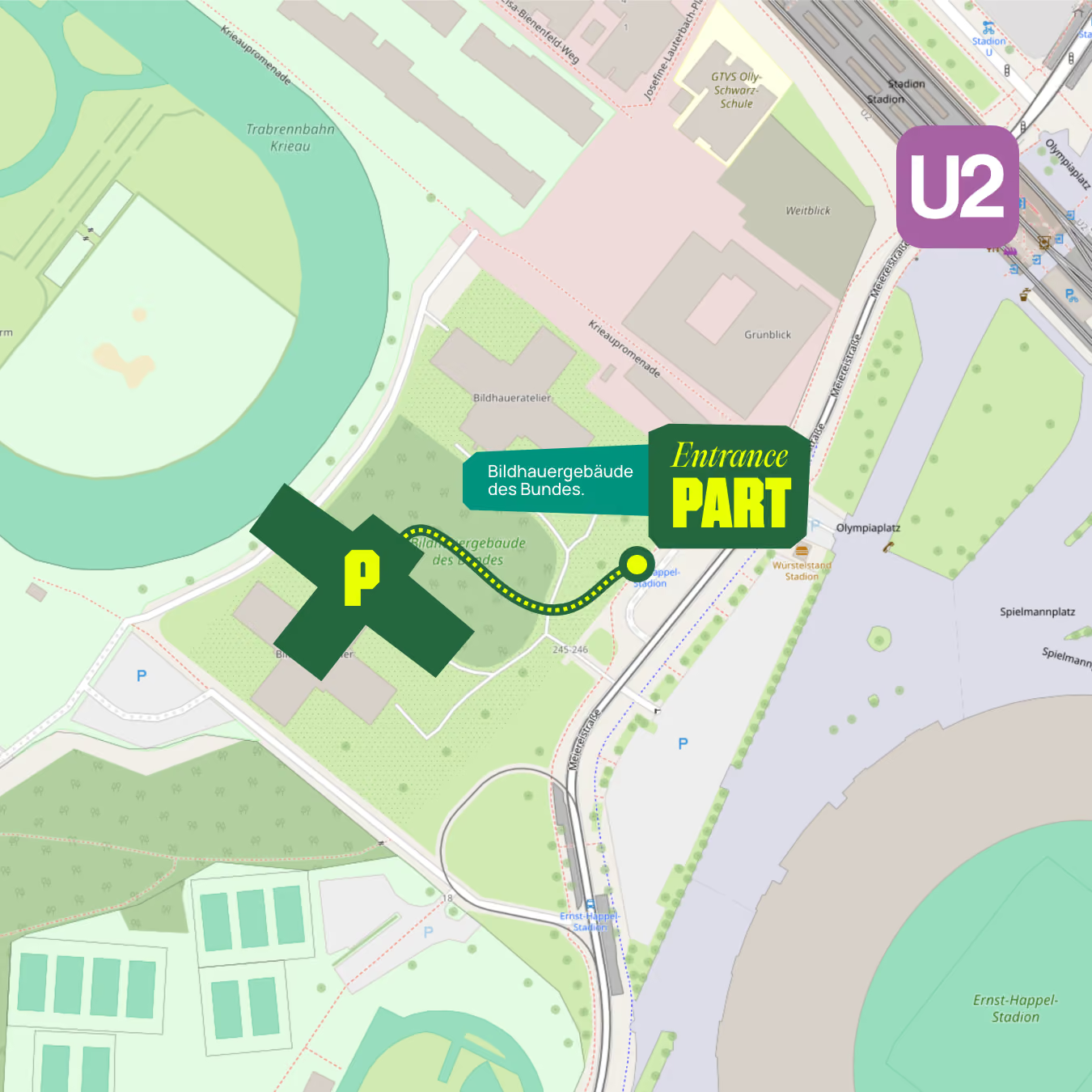
HOW TO FIND US