Exhibition "persona. fragments of identity" 05.09. - 16.10.2026 @ THE HALL
With works by Odie Lap Chun Chow (HK), Edith Karlson (EE), Jakob Lena Knebl (AT), Yein Lee (KR/AT) and Paulina Semkowicz (PL/AT).
Exhibition duration: 05.09. – 16.10.2026
Opening hours: Fri 1 pm – 6 pm, Sat 12 pm – 5 pm and by appointment welcome@partresidency.at
Finissage/Curator’s Talk: 16.10.2026, 5 pm
Welcome to persona.
There is one sentence that has stayed with me throughout the making of this exhibition. It comes from Ingmar Bergman’s 1966 film Persona. Alma says to Elisabet:
“I think I could turn into you if I really tried.”
This sentence also gave the exhibition its title. For me, it captures something at the heart of Persona: the unsettling yet intimate possibility that, by looking closely at another person, observing them, imitating them, or trying to understand them, we might begin to become them. Where does one person end and another begin?
This question became one of the starting points for the exhibition.
Persona is not really about masks in the literal sense. It is about the moments when we put on a form, inhabit a role, become someone else, or discover that we have already been doing so without realizing it. It is about the distance, sometimes very small, between who we are, who we think we are, and what other people see when they look at us.
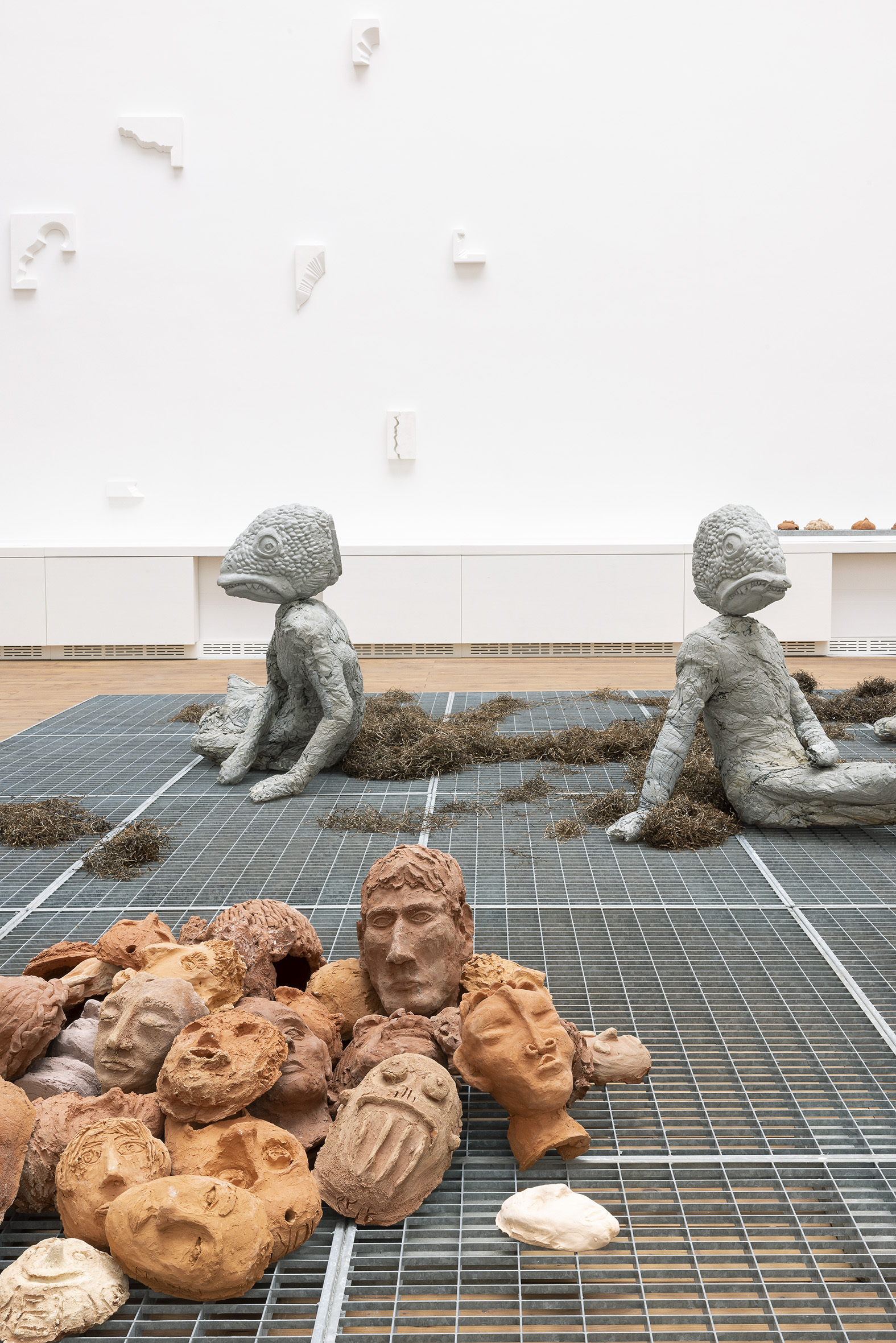
And perhaps this is why Edith Karlson’s sirens were the right place to begin. Edith takes a familiar mythical figure and turns it around. Instead of the traditional woman with a fish tail, we encounter human bodies with fish heads, strange beings that seem to have emerged from somewhere beneath the surface of the human. They are unsettling, but also strangely tender.
They made me think of another sentence, this time from Argentinian author Jorge Luis Borges:
“The first to awaken shall be the Fish. (…) Then, other forms will begin to awaken. Gradually they will become different from us; gradually they will no longer imitate us.”
Edith’s creatures seem to exist in precisely this moment of transformation. They are no longer entirely human, but they have not become something entirely other. Their transformation does not feel like a loss of identity. Instead, it feels like another identity coming through.
This question continues inEdith’s collection of self portraits. Since 2020, people from different backgrounds have made portraits of themselves from Estonian clay in her studio. Looking at them, I was struck by how different a person can become when they try to reproduce themselves. A portrait can look like us and still not be us. It can reveal something precisely through the things it gets wrong.
Yein Lee’s sculptures seem to belong to a world that has not yet been given a proper taxonomy. They are somewhere between bodies, machines, organisms and imagined creatures. And then they are given names: Dispatcher,Watcher, and other functional identities. Suddenly, something amorphous becomes a role. A creature becomes a character. Naming becomes a way of giving an identity to something that was previously unknown.
Jakob Lena Knebl takes this idea into the territory of performance. In their work, identity can be dressed, arranged, inhabited and rehearsed. A body can become a role, an object can become a prop, and the boundary between who we are and who we perform becomes wonderfully unstable.Ashley and Lena. Lena and Ashley.
This brings us back to Ingma rBergman’s Persona. The film follows Elisabet, an actress who suddenly stops speaking, and Alma, the nurse assigned to care for her. As their relationship develops, the distinctions between the two women begin to collapse. One observes while the other performs. They imitate each other. They begin to speak through one another.
Perhaps they are merging. Perhaps they are revealing themselves as two manifestations of the same divided self.
The word persona originally referred to the theatrical mask worn by an actor. Later it came to mean the character represented on stage, and eventually, in Carl Gustav Jung’s psychology, the social face we present to the world.
I find this history fascinating because the persona is not simply a false version of ourselves. We need it. We use it to enter the world, to communicate, to play our roles. But at the same time, the mask can become so familiar that we no longer know where the mask ends and the person begins.
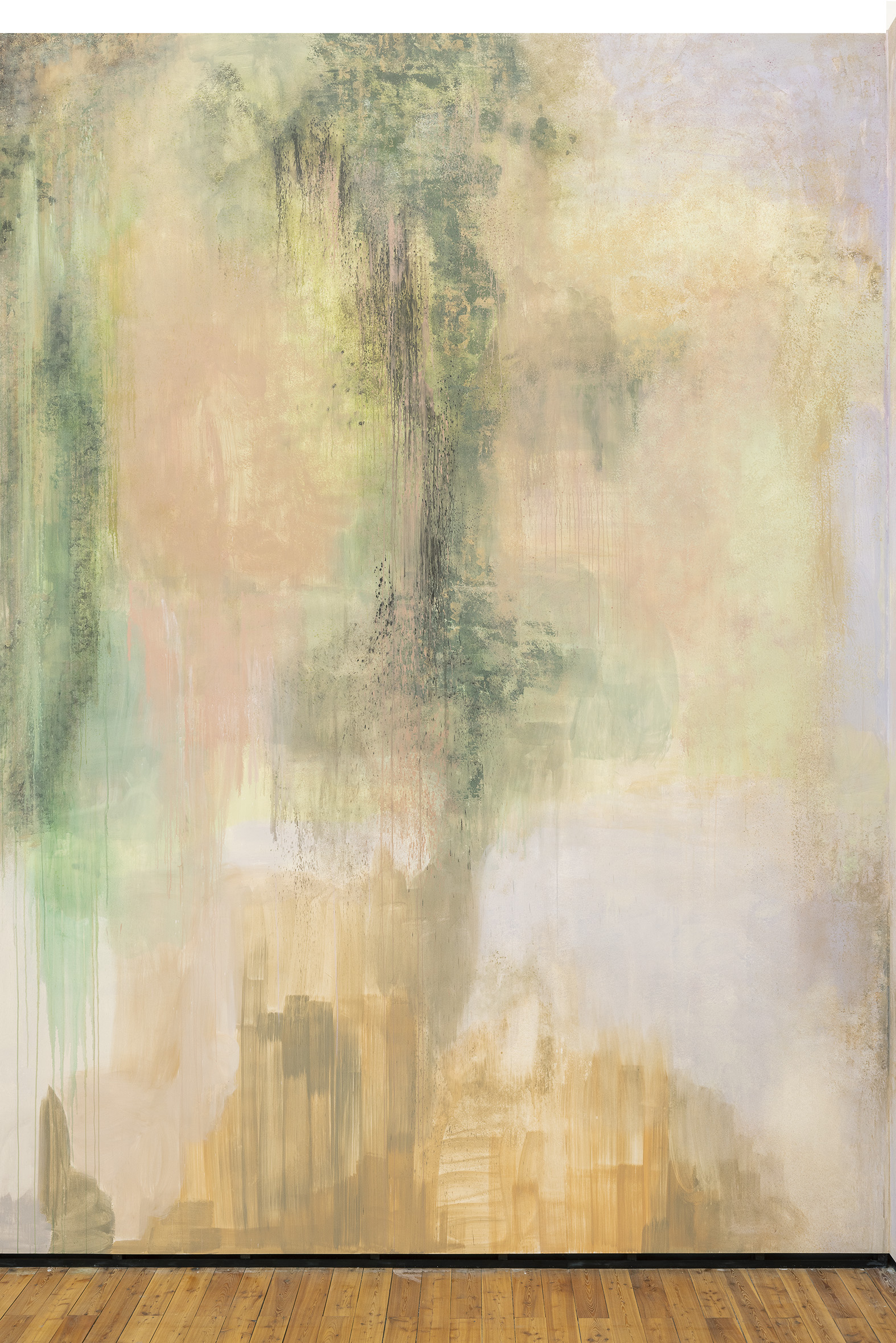
With Paulina Semkowicz, the question shifts from the body to the space around it: can a room, too, take on a persona?
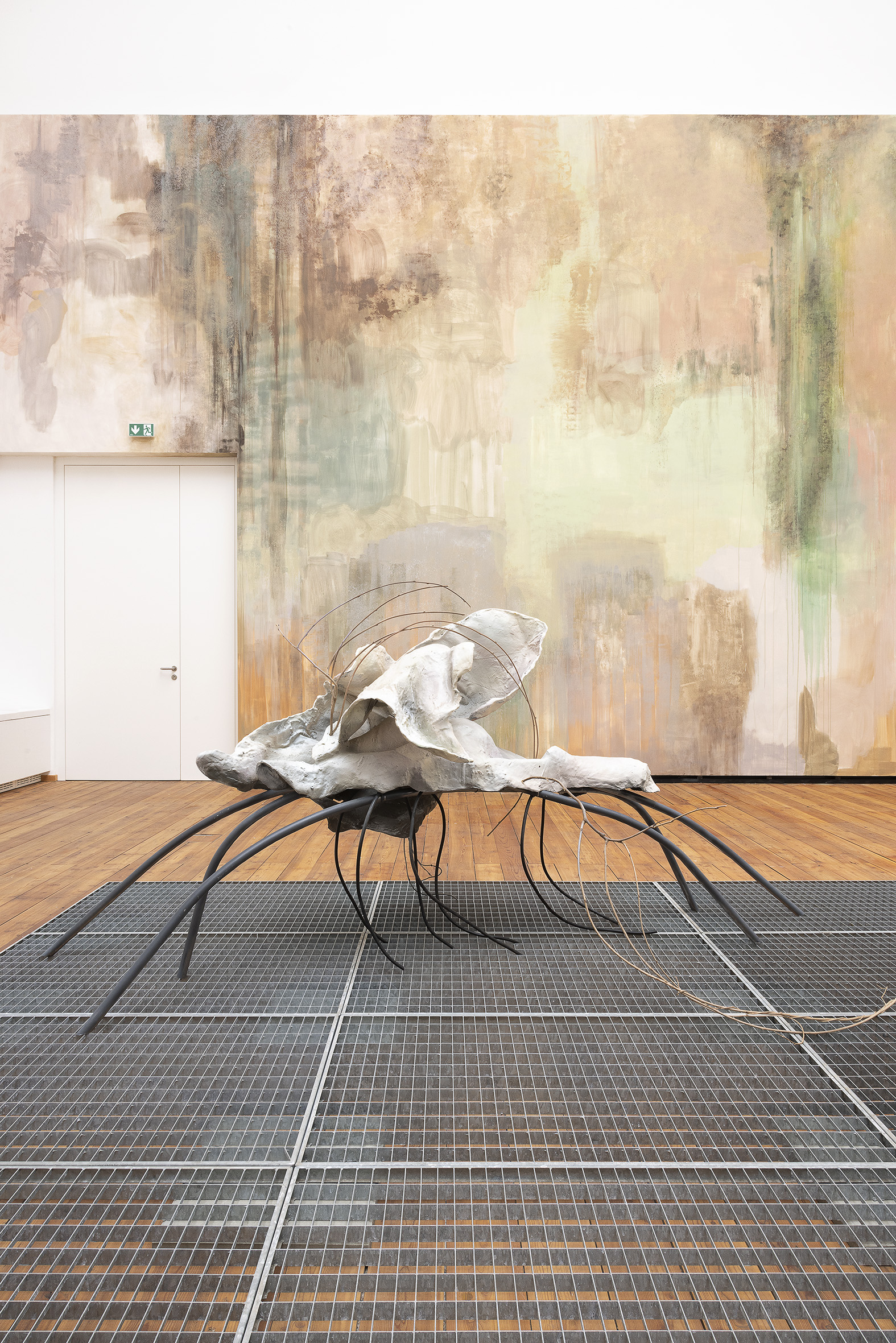
Her painted interiors feel like places we might remember without ever having visited them. They are rooms, stages, fragments of architecture caught somewhere between inhabitation and disappearance. Their surfaces carry moisture, moss, mold, patina and decay. And because the work is situated within this historic building, the painting seems to enter into a conversation with the architecture itself.
Odie Lap Chun Chow approaches identity from yet another direction: through absence. His work connects to the long history of casting and reproduction. But instead of being interested only in the surface of an existing body, he turns our attention toward the mold, toward the empty space that makes another form possible. I find this idea particularly moving: that absence is not necessarily emptiness. That a negative space can contain a possibility. That what is missing can also be what allows something new to appear.
And this is perhaps also what the architecture of the exhibition tries to do.
The silver grid turns THE HALL into a kind of stage. The works inhabit it like actors, bodies, characters or provisional personas. They appear to be performing for one another, but also for us.
Persona is ultimately about the fact that identity is never quite as fixed as we like to believe.
We are constantly being named, interpreted, dressed, photographed, remembered, performed and imagined by others. And we do the same to ourselves. We construct ourselves from fragments. We try on identities. Sometimes they fit. Sometimes they don't. Sometimes we grow into them. Sometimes they begin to grow beyond us.
So perhaps the persona is not something that hides the real self underneath.
Perhaps the persona is the place where the self is continually being made.
And perhaps this is what has stayed with me most from Bergman’s sentence: I think I could turn into you if I really tried.
Text by Barbara Horvath
Edith Karlson's works: Courtesy of the artist & Temnikova & Kasela Gallery, Tallinn
Jakob Lena Knebl's work: Courtesy of the artist & Galerie Loevenbruck, Paris
Odie Lap Chun Chow is an artist in residence at PART from August to September. Edith Karlson will be an artist in residence from December 2026 to January 2027.
Supported by the Embassy of Estonia Vienna, the Polish Institute and Lenox-Trading.

.jpeg)